Summary
Background
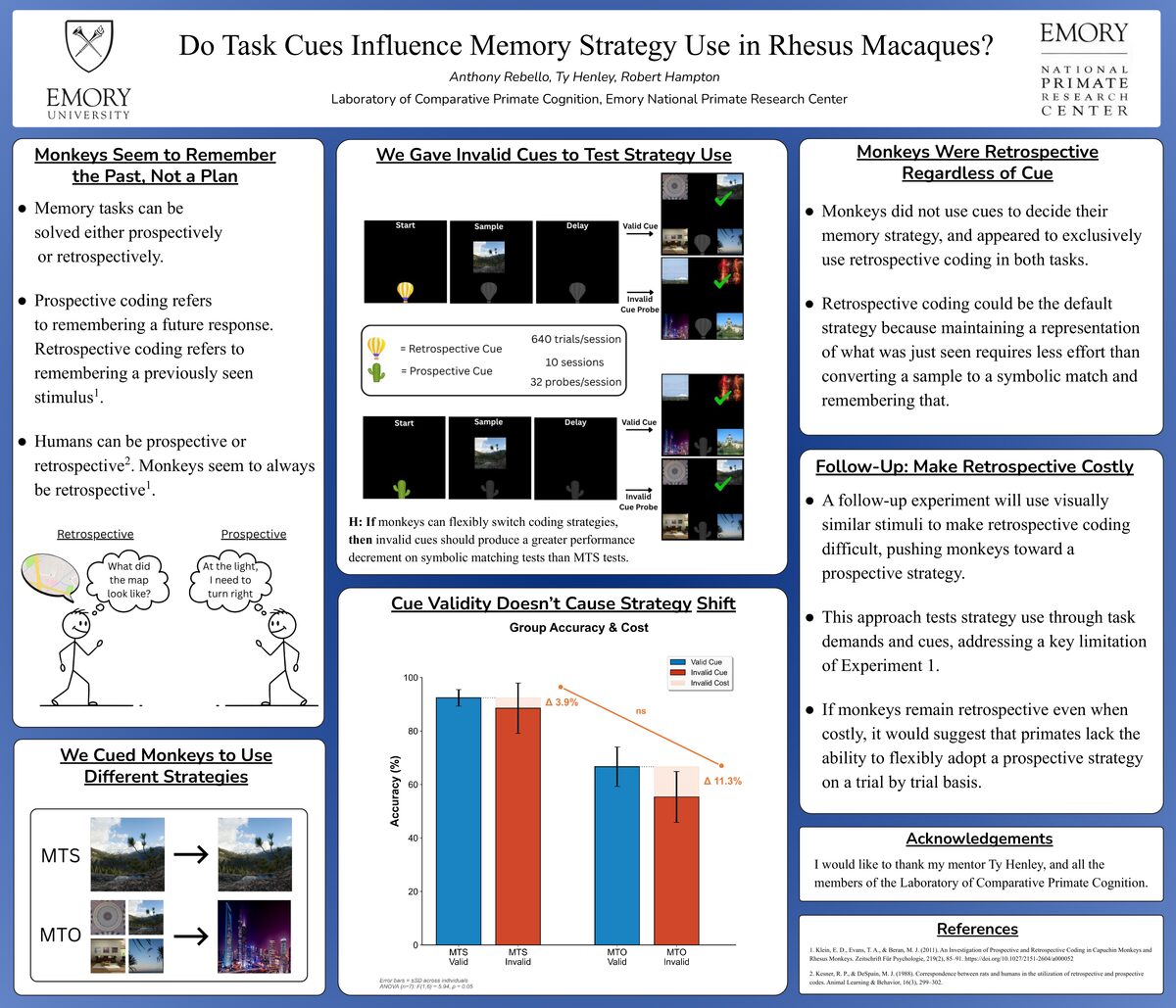
Memory tasks can be solved either prospectively or retrospectively. Prospective coding means remembering a future response; retrospective coding means remembering a previously seen stimulus. Humans can use either strategy, whereas rhesus macaques have appeared to rely on retrospective coding.
Approach
We cued monkeys toward different strategies using two touchscreen tasks: a match-to-sample (MTS) task and a symbolic, many-to-one (MTO) matching task. To test whether the animals actually used the cues to choose a strategy, we introduced invalid cues on probe trials. If monkeys can flexibly switch coding strategies, invalid cues should produce a greater performance cost on the symbolic matching tests than on the MTS tests.
Findings
Cue validity did not cause a strategy shift. Monkeys did not use cues to decide their memory strategy and appeared to use retrospective coding exclusively in both tasks. Retrospective coding may be the default because maintaining a representation of what was just seen requires less effort than converting a sample to a symbolic match and holding that in mind.
Next steps
A follow-up experiment will use visually similar stimuli to make retrospective coding difficult, pushing monkeys toward a prospective strategy. This tests strategy use through task demands as well as cues, addressing a key limitation of the first experiment. If monkeys remain retrospective even when it is costly, it would suggest that these primates lack the ability to flexibly adopt a prospective strategy on a trial-by-trial basis.
Poster
Cite
Rebello, A., Henley, T., & Hampton, R. R. (2026, April 11). Do Task Cues Influence Memory Strategy Use in Rhesus Macaques? [Poster presentation]. Georgia Southern Psychological Society Conference, Georgia, United States. https://anthonyhrebello.com/publications/task-cues-memory-strategy-rhesus-macaques-2026
@misc{rebello2026taskcues,
  title        = {{Do Task Cues Influence Memory Strategy Use in Rhesus Macaques?}},
  author       = {Rebello, Anthony and Henley, Ty and Hampton, Robert R.},
  year         = {2026},
  month        = apr,
  howpublished = {Poster presented at the Georgia Southern Psychological Society Conference},
  url          = {https://anthonyhrebello.com/publications/task-cues-memory-strategy-rhesus-macaques-2026}
}
References
- Klein, E. D., Evans, T. A., & Beran, M. J. (2011). An investigation of prospective and retrospective coding in capuchin monkeys and rhesus monkeys. Zeitschrift für Psychologie, 219(2), 85–91. doi:10.1027/2151-2604/a000052
- Kesner, R. P., & DeSpain, M. J. (1988). Correspondence between rats and humans in the utilization of retrospective and prospective codes. Animal Learning & Behavior, 16(3), 299–302.
Contact
Get in touch
I’m always happy to discuss comparative cognition, working memory, research methodology, or potential collaborations. Feel free to reach out via email.
Atlanta, GA · PhD Student · Georgia State University